 As a proof reader, it’s vitally important that you keep up with the latest neologisms. You don’t want to mark up a proof, confident that you’ve highlighted some real humdingers, only to discover the only thing you’ve successfully drawn attention to is your own inability to ‘get with the times’ (that’s how the kids put it, I believe).
Take a good look at your dictionary. If it looks like something that’s been rescued from a war zone (and smells like something from an Edgar Allen Poe story), it’s probably time to invest in a new one. New words are added to the English vocabulary every year. So, the older your dictionary, the more impoverished your vocabulary is likely to be. There are a number of great (and entirely free) online dictionaries to choose from. If, like me, however, you gain a certain amount of comfort from the physical artefact of a ‘real’ book (the rustle of paper, the smell of ink and page preserver), why not pop along to our Amazon store and browse away. The following neologisms are from the revised eleventh edition of the Concise Oxford English Dictionary. abdominoplasty n. Medicine a surgical operation involving the removal of excess flesh from the abdomen. aerobicized or aerobicised adj. (of a person's body) toned by aerobic exercise: aerobicized Hollywood women. agroterrorism n. terrorist acts intended to disrupt or damage a country's agriculture. – derivatives: agroterrorist n. bahookie n. Scottish a person's buttocks. – origin 1930s: prob. a blend of behind and hough + -ie. best – phrases: best of breed – any item or product considered to be the best of its kind. blowback n. 2. chiefly US the unintended adverse results of a political action or situation. celebutante n. a celebrity who is well known in fashionable society. – origin 1930s: blend of celebrity and debutante. crunk n. a type of hip-hop or rap music characterized by repeated shouted catchphrases and elements typical of electronic dance music, such as prominent bass. adj. US, chiefly black slang (of a person) very excited or full of energy. – origin 1990s: perh. an alt. past part. of crank1 or a blend of crazy and drunk. elephant – phrases: the elephant in the room a major problem or controversial issue which is obviously present but avoided as a subject for discussion because it is more comfortable to do so. emulsion n. 1. – a fine dispersion of one liquid or puréed food substance in another: ravioli with pea and ginger emulsion. hardscape n. chiefly US the man-made features used in landscape architecture, e.g. paths or walls, as contrasted with vegetation. – derivatives hardscaping n. hoody (also hoodie) n. – informal a person, especially a youth, wearing a hooded top. – origin 1960s: of unknown origin. mentee n. a person who is advised, trained, or counselled by a mentor. mesotherapy n. (in cosmetic surgery) a procedure in which multiple tiny injections of pharmaceuticals, vitamins, etc. are delivered into the mesodermal layer of tissue under the skin, to promote the loss of fat or cellulite. mzee n. (in East Africa) an older person; an elder. – origin Kiswahili, 'ancestor, parent, old person'. obesogenic adj. tending to cause obesity. plank n. 3. Brit. informal a stupid person. ponzu n. (in Japanese cookery) a sauce or dip made with soy sauce and citrus juice. – origin Japanese, from pon 'smack, pop' + zu, from su 'vinegar'. radge Scottish informal n. a wild, crazy, or violent person. adj. wild, crazy, or violent. – origin 1920s: appar. an alt. of rage. rendition n. 3. (also extraordinary rendition) (especially in the US) the practice of sending a foreign criminal or terrorist suspect covertly to be interrogated in a country with less rigorous regulations for the humane treatment of prisoners. retronym n. a new term created from an existing word in order to distinguish the original referent of the existing word from a later one that is the product of progress or technological development (e.g. acoustic guitar for guitar). – origin 1980s: blend of retro- and -onym. riffage n. informal guitar riffs, especially in rock music. shoulder-surfing n. the practice of spying on the user of a cash-dispensing machine or other electronic device in order to obtain their personal identification number, password, etc. – derivatives: shoulder-surfer n. SIPP n. (in the UK) a self-invested personal pension, a pension plan that enables the holder to choose and manage the investments made. therapize or therapise v. subject to psychological therapy: you don't need to therapize or fix each other. tri-band adj. (of a mobile phone) having three frequencies, enabling it to be used in different regions (typically Europe and the US). twonk n. Brit. informal a stupid or foolish person. – origin 1980s: perh. a blend of twit1 or twat and plonker. upskill v. [often as noun upskilling] teach (an employee) additional skills. • (of an employee) learn additional skills. wedge issue n. US a very divisive political issue, regarded as a basis for drawing voters away from an opposing party whose supporters have diverging opinions on it. Yogalates (also trademark Yogilates) n. a fitness routine that combines Pilates exercises with the postures and breathing techniques of yoga. – origin 1990s: blend of yoga and Pilates. zombie n. 3. a computer controlled by a hacker without the owner's knowledge, which is made to send large quantities of data to a website, making it inaccessible to other users.
2 Comments
“...we’ve got a spell checker! Get with the times! Your skills have been supplanted by computer technology! Welcome to the Space Age!”
Okay, I’m exaggerating a little, but that’s what I get for watching The Treasure of the Sierra Madre one too many times. That said, you may find, as a proofreader seeking out work opportunities you often encounter what I call ‘the spell checker defence’: “What do we need a proofreader for? Microsoft Word checks our spelling and grammar.” If you’ve read The No-Nonsense Proofreading Course, you’ll know that I’m not entirely opposed to spell checkers (and if you haven’t read The No-Nonsense Proofreading Course... what’s keeping you?). Spell checkers have their place in the proofreader’s toolbox. In the hands of someone other than a proofreader, however, they’re a positive liability. Now for a statement that might for some seem a little counterintuitive (or just plain wrong): Spell checkers can’t detect spelling mistakes. What? It’s true. They can’t. What a supposed ‘spell checker’ actually does is highlight words that do not feature in its database. That’s a very different thing. If the word features in its database, Mr Spell Checker just nods and moves on, irrespective of whether or not it’s the right word. To illustrate just how problematic this can be, let’s take a look at some memorable opening lines. It is a truth universally acknowledged, that a single man in possession of a good fortune, must be in want of a wipe. Jane Austen, Pride and Prejudice It was a pleasure to burp. Ray Bradbury, Fahrenheit 451 The following, from the opening of Faulkner’s The Sound and the Fury, could have provided a particularly illuminating example, but in the interest of good taste, I’ll leave it to you to decide just how horribly wrong things can go if left to the devices of our mindless Mr Spell Checker. Through the fence, between the curling flower spaces, I could see them hitting. Not very pleasant, I know. 20 years ago, when I was copywriter and, by default, proofreader at McGee, Parsons and Associates, I was prevented from proofreading a skiwear catalogue by a client who wished to save money. He declared that he had a perfectly good grasp of the English language and could proofread it for himself. Unfortunately, he didn’t proofread it; he handed it over in its vulnerable entirety to his good friend Mr Spell Checker. In the finished, printed and handsomely bound catalogue a reference to ‘luxurious casual wear’ appeared as ‘luxurious casual sex’. Oops. To say the least. After that, as you can imagine, the client in question always considered the modest outlay for the services of an effective proofreader as money very well spent. If anyone ever asks you what a proof reader does, for heaven’s sake don’t start talking about spelling mistakes and grammatical errors right off the mark. You’ll see their eyes glaze over in under a minute and they’ll do that stretching-mouth, flaring-nostrils thing which means they’re yawning but they don’t want to hurt your feelings so they’re trying to kind of seal it in. Do you remember that scene in Dead Poets’ Society when Robin Williams as John Keating asks his class for which single endeavour language was developed? He receives the unimaginative answer of “To communicate” and swiftly counters with, “No! To woo women!” Well, the ‘what does a proof reader do’ question should be tackled in pretty much the same way. That isn’t to say we proofread in order to dazzle the opposite sex (although, why not? Why not?), but it most certainly is about more than just spelling errors and grammatical blunders. We proofread to spare blushes. We proofread to protect our employers and clients from embarrassment. Let’s take a look at the kind of embarrassment, in fact the sheer humiliation which the strategic deployment of an effective proof reader would quickly have nipped in the bud. In December of last year, a school teacher spotted a spelling error on Monmouthshire Council’s recycling bags. The instruction to ‘separate’ various materials for recycling purposes was printed as ‘seperate’. An easy mistake to make, and not an uncommon one. Hardly humiliating, you might think. However, the teacher in question, Helen Pritchard, took the recycling bag to her class at Llanvihangel Crucorney School and asked her 20 pupils if they could spot the mistake. Without exception, the primary level students nailed it. They then wrote a letter to the council (see below) expressing their disapproval. 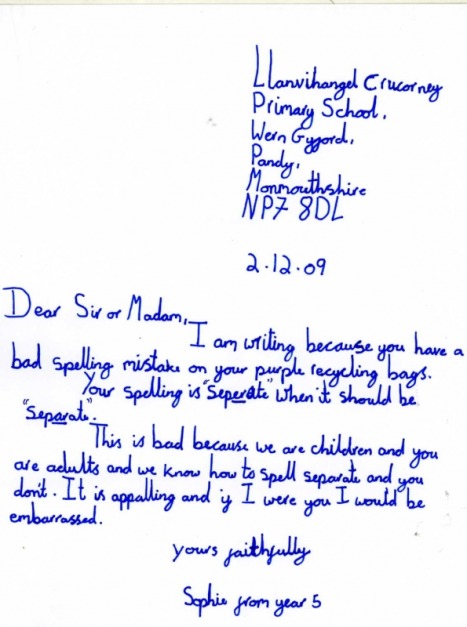 A Proof Reader is Born Okay, having a classroom full of ten-year olds admonish you for poor spelling is a little embarrassing but still a few lengthy strides away from ‘humiliating’.
Well, this little episode made it into the local press. Okay, we’re edging toward humiliating now, but we’re not all the way there yet. Then, the piece was taken up by the BBC and featured on their website. The BBC website receives 1.2 million page views and 80 million hits per month. Like I said: humiliating. So, we proof readers don’t simply expose spelling errors and grammatical slip-ups. No, we shield our employers and clients from the searing heat of unwanted publicity in a media-soaked era. Okay, so we do that by trawling for spelling mistakes and poorly-executed English, but that's not going to hold anyone's attention at a dinner party, is it? Proofreading. It’s an odd profession, isn’t it? Spending your days scouring someone else’s documents for spelling errors and grammatical imperfections? It’s no surprise that proof readers are perceived as strange little creatures: hunched as we are over our proofs, red pen in hand, obsessing over the tiniest details. We need quiet. We can’t be doing with distractions. We seem like an antisocial bunch. But we’re just getting on with our work. We’re just doing our bit. And we’re proud of our contribution, aren’t we? Aren’t we? Well, not always. In fact, not often. Too frequently, we regard ourselves as the interfering busybodies of the publishing world, the nosy neighbour with the perpetually-twitching net curtain. We don’t create anything. We don’t produce anything. Whatever we work on, we can’t genuinely lay claim to the end product. Well, maybe that’s true. Maybe we can’t lay claim to a document in its entirety, but we do make a very legitimate and substantial contribution to the health and wellbeing of a document and, by extension, the business or organisation said document promotes or represents. Errors cost money. Errors incur bad publicity. Errors can take the shine off an otherwise pristine reputation. The work we do is not only important, it’s vital. And we should be proud. Which is why we’ve produced a range of handsome-looking merchandise over at our store. Let’s celebrate our status as proof readers. Let’s tell the world what it is we do and how hopelessly devoid of quality the published word would be without us. Say after me, “I’m proud to be a proof reader!” 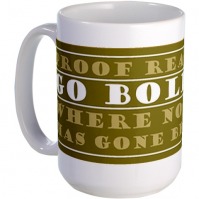 One of our 'Proof Readers Go Boldly Where No Man Has Gone Before' mugs  Well, this is it. Day one. The No-Nonsense Proofreading Course is now available to buy.
It's taken the better part of a year to condense 20 years of proofreading experience into a single, no-nonsense ebook. I'm very pleased with the result and I hope you'll agree. But this website isn't just a piece of elaborate salesmanship intended to convince you to part with your hard-earned cash; it's also a resource in its own right, containing a wealth of proofreading knowledge and information and lots of links to useful websites. So, please subscribe to our RSS feed. You won't want to miss out. Next time, we'll be looking at proofreading etiquette. |
Testimonials
“I am one of those many fools who paid a huge amount of money for a useless course. This book... has opened so many doors for me. I now look on Mike as my mentor as I embark on a career. Thank you Mike.” Emma Steel, Proofreader and International Structural Editor. “ I thoroughly enjoyed the course and am so glad that I decided to take it... the whole experience was invaluable. My proofreading service is now well established and your course played no small part in getting it off the ground.” Hache L. Jones, Proofreader. “I'd just like to thank you first of all for writing such a great, straight forward eBook, and then going above and beyond what I would even expect as a customer by providing us, completely free of charge, updated versions months later!” Rachel Gee, Trainee Proofreader. “What can I say? Worth every penny and then some! God Bless! This a fabulous course.” Teresa Richardson, Proofreader. “As someone who has effectively been proofreading for thirty years, I found Mike’s No-Nonsense Proofreading Course an invaluable introduction and a very useful practical guide to many aspects of this discipline. I can wholeheartedly recommend it as the ideal starting point, and much more besides.” Jeremy Meehan, Proofreader. Blog AuthorMy name's Mike Sellars and I'm an experienced proofreader and the author of The No-Nonsense Proofreading Course. Click here to find out more about me. 
The No-Nonsense Proofreading CourseA Fraction of the Cost of Other Proofreading Courses NOTE: Stock is currently limited to 10 per day, so we can continue to deliver exceptional after-sales service, answer queries and provide open-door support. Credit card and PayPal payments accepted. “As someone who has been proofreading for 30 years, I found Mike’s course an invaluable introduction and a very useful practical guide to many aspects of the discipline. I can wholeheartedly recommend it.” Jeremy Meehan, Proofreader. Still want to find out more? Click here. Proofreading Categories
All
Proofreading Archives
December 2023
|
 RSS Feed