|
2/23/2025 The Birth of Punctuation: the Question Mark, the Exclamation Mark and the Semicolon.Read Now The Birth of Punctuation: When the ‘?’, ‘!’ and ‘;’ First Made Their Mark
Punctuation is something we take for granted every day. We don’t even think twice about the question marks, exclamation points, and semicolons dotting our sentences, guiding our meaning like silent signposts. But have you ever stopped to wonder—where did they come from? Who was the first person to say, “You know what this sentence needs? A squiggly thing with a dot under it!”? Let’s take a trip through history and explore the fascinating first appearances of the question mark, the exclamation mark, and the semicolon. The Question Mark: From Curved Inquiry to Common Use The question mark (?) is one of the most universally recognized symbols in punctuation. But how did it come to be? The origins of the question mark are somewhat debated, but one of the most widely accepted theories is that it evolved from the Latin word quaestio, meaning “question.” Medieval scribes, who had the unenviable task of copying texts by hand, developed shorthand notations to speed up their work. To indicate a question, they often wrote “Qo” at the end of a sentence. Over time, this abbreviation is believed to have morphed into a symbol resembling our modern question mark—where the ‘Q’ turned into the curved line and the ‘o’ became the dot below it. The first known use of a recognizable question mark in print appeared in the late 8th or early 9th century, thanks to the scholarly efforts of Alcuin of York, an advisor to Charlemagne. He was a key figure in the Carolingian Renaissance and helped standardize written language, including punctuation. Though it took a few centuries for the question mark to become standard in writing, by the 15th century, it was a staple of European texts. The Exclamation Mark: A Shout from the Middle Ages The exclamation mark (!) has an equally lively history. Also called the “exclamation point” in American English, this punctuation mark conveys excitement, surprise, or strong emotion. Like the question mark, its origins trace back to medieval scribes who sought ways to indicate tone in writing. One theory suggests that the exclamation mark evolved from the Latin word io, an expression of joy. Scribes would write io at the end of sentences to denote exclamation. Over time, the ‘I’ was placed above the ‘o’, forming a shape remarkably similar to the exclamation mark we use today. The first clear recorded use of an exclamation mark in print dates to the 14th century, though it wasn’t widely adopted until the 15th century. Even then, it was a rare sight, as early printers tended to save punctuation marks for where they were absolutely necessary (parchment and paper were valuable, after all!). The exclamation mark only became a common feature in written texts by the 18th century, when more expressive punctuation was encouraged in literature. The Semicolon: The Aristocrat of Punctuation The semicolon (;) is often misunderstood today—too formal for casual use, yet not quite as decisive as a period. But when it first appeared, it was a revolutionary addition to punctuation. We owe the semicolon’s first appearance to the Italian printer Aldus Manutius, who introduced it in 1494. Manutius was a visionary in typography and publishing, famous for developing the italic typeface and popularizing small, portable books. The semicolon was his way of offering writers more flexibility—a middle ground between a comma and a full stop. Originally, the semicolon was used to separate closely related but independent clauses, much as we use it today. Manutius’s innovation spread, and by the 16th century, writers like Ben Jonson and later, Shakespeare, had embraced the semicolon in English literature. Punctuation’s Journey Through Time It’s incredible to think that these tiny marks, which we use every day without a second thought, have such rich and winding histories. The question mark, exclamation mark, and semicolon have all had their own evolution, shaped by medieval scribes, Renaissance printers, and modern authors alike. Without them, our written language would be a monotonous stream of words, lacking tone, structure, and clarity. So, the next time you see a question mark at the end of a sentence, an exclamation mark shouting from the page, or a semicolon elegantly linking ideas, take a moment to appreciate the centuries of history behind them. Language is always evolving, and who knows? Perhaps new punctuation marks will emerge in the future to help us express ourselves in ways we can’t yet imagine! The No-Nonsense Proofreading Course If you'd like to put your punctuation know-how to good use (and turn it into an income), why not take a look at The No-Nonsense Proofreading Course, the best value proofreading instruction online. Click here to find out more.
0 Comments
|
Testimonials
“I am one of those many fools who paid a huge amount of money for a useless course. This book... has opened so many doors for me. I now look on Mike as my mentor as I embark on a career. Thank you Mike.” Emma Steel, Proofreader and International Structural Editor. “ I thoroughly enjoyed the course and am so glad that I decided to take it... the whole experience was invaluable. My proofreading service is now well established and your course played no small part in getting it off the ground.” Hache L. Jones, Proofreader. “I'd just like to thank you first of all for writing such a great, straight forward eBook, and then going above and beyond what I would even expect as a customer by providing us, completely free of charge, updated versions months later!” Rachel Gee, Trainee Proofreader. “What can I say? Worth every penny and then some! God Bless! This a fabulous course.” Teresa Richardson, Proofreader. “As someone who has effectively been proofreading for thirty years, I found Mike’s No-Nonsense Proofreading Course an invaluable introduction and a very useful practical guide to many aspects of this discipline. I can wholeheartedly recommend it as the ideal starting point, and much more besides.” Jeremy Meehan, Proofreader. Blog AuthorMy name's Mike Sellars and I'm an experienced proofreader and the author of The No-Nonsense Proofreading Course. Click here to find out more about me. 
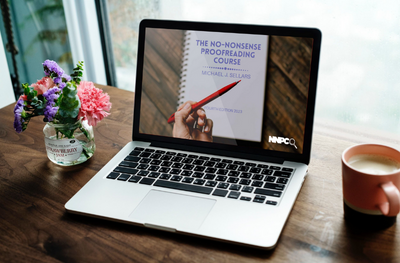
The No-Nonsense Proofreading CourseA Fraction of the Cost of Other Proofreading Courses NOTE: Stock is currently limited to 10 per day, so we can continue to deliver exceptional after-sales service, answer queries and provide open-door support. Credit card and PayPal payments accepted. “As someone who has been proofreading for 30 years, I found Mike’s course an invaluable introduction and a very useful practical guide to many aspects of the discipline. I can wholeheartedly recommend it.” Jeremy Meehan, Proofreader. Still want to find out more? Click here. Proofreading Categories
All
Proofreading Archives
February 2025
|
 RSS Feed